

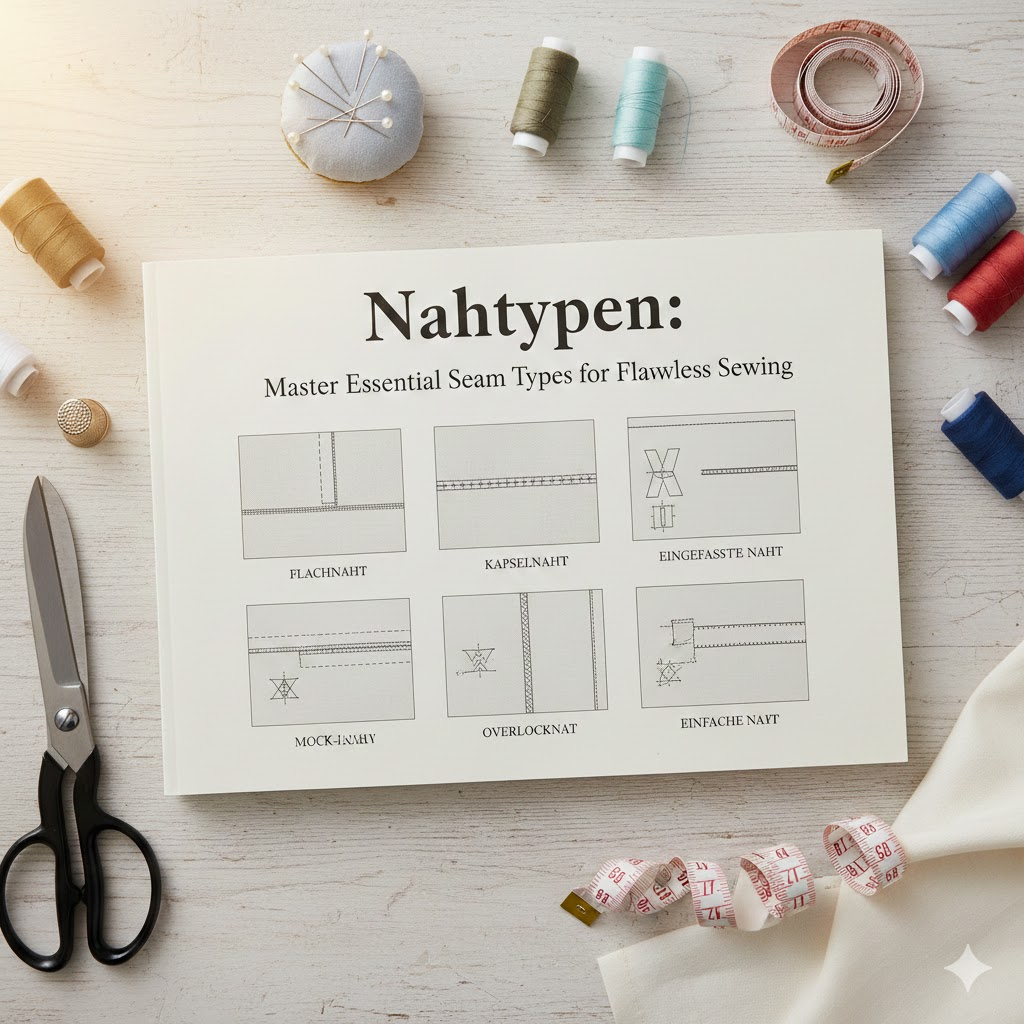
Do you ever wonder why some handmade clothes look beautiful and well-made, while others are pretty terrible and don’t last? The secret often lies in something most sewers never think about: selecting the right seam.
Introducing nahttypen* — the German word for “seam types” – is your passport to lifelong, durable, beautiful sewing projects. Whether you’re sewing your first pillowcase or building a bespoke jacket, the seams you choose dictate everything from strength to finish.
You’ll learn about different types of seams, how they work and when to use them, and wise tips that will immediately improve your sewing skills.
What is Nahttypen?
Nahttypen simply means “types of seams” in English, and they are wells they you put fabric together. Consider seams the hidden architecture in everything sewn — they secure all of your pieces while dictating how clothes wear, move and even last.
Each seam has its own function. Others value strength and durability, so are excellent for jeans and workwear. Others specialize in smooth finishes for such delicate fabrics as silk or chiffon.
The cool thing about mastering nahttypen is that it turns you from a person who just sews some stuff together to become an artist, someone who makes well-considered decisions. You’ll learn why, precisely, a French seam has a rightful place on that sheer blouse or denim calls for flat-felled construction.
Types of Nahttypen: What Every Sewer Should Know
Straight Seam This is where it all begins: the foundation of sewing that you’ll use for most simple everyday projects. It makes a clean, neat seam where two pieces of fabric are joined, and it is lovely with woven fabrics such as cottons, line and quilting cottons. But it is not stretchy, so do not use on knits or fabrics with spandex.
Zigzag Seam For stretchy fabric, the zigzag seam is your friend. This stitch stretches with stretch fabrics, ensuring that your stitches won’t pop like they do on standard straight seams while sewing stretch garments. It’s also, in a way, two tools in one that does double duty by completing raw edges and helping to prevent fraying.
French Seam Also known as the “couture seam,” this wonderful technique completely encases raw fabric edges for a perfectly clean look. If you are sewing sheers or other delicate fabrics, this seam will prevent fraying and look as nice on the inside of your garment as it does on the outside.
Flat-Felled Seam Look inside any pair of well-made jeans and you’ll find this rugged construction. The exposed double stitching of the flat-felled seam increases durability, which is why this type of stitched seam is great for apparel pieces that require frequent washing and wearing.
Overlock Seam This versatile stitched seam is made with a serger sewing machine, and it sews, trims, and finishes seams all in one step. It’s what makes commercial clothing look factory perfect and keeps edges from fraying over time.
Nahttypen for the Appropriate Project
The choice of seam doesn’t have to be intimidating. Begin by asking yourself three easy questions concerning your project.
What’s your fabric weight and blend? Lightweight fabrics such as silk call for an enclosed seam, like French construction: heavy denim requires a reinforced one, like a flat-felled seam. Stretchy knits require a stretch-compatible zigzag or overlock stitch.
What’s the garment’s purpose? For this type of workwear, as well as for products that are subjected to frequent stress or wear and tear, double sewn seams or reinforced ones are advantageous. Decorative ones can feature their beauty on the top through topstitching or contrasting threads. Athletic wear requires stretch-friendly construction.
What finish do you want? Think about both exterior look and interior finish. Some patterns really do require clean seams enclosed within an elaborate network of binding or bias tape; and for some, the two layers can be snipped off with a pinking shears at the side edges.
It is definitely worth testing your chosen seam on a scrap of fabric before using it on your actual project, you’ll be saving yourself some frustration and extra material. Change your machine settings, threads tensions and make sure you’re using the right needle size for the thickness of your fabric.
Practical Benefits of Mastering Nahttypen
Exploring different types of seams opens up possibilities on your sewing journey. Here is why you are going to love us: First, your projects will look FANTASTIC — good seaming is critical if you want that hand knit item to look professionally made.
When you are sewing with seams sewn to fabric specifications, durability jumps leaps and bounds. Clothes stand up to the constant washing and wearing with no stress points breaking down. You will spend less time fixing issues, and more time making something new.
Your creative possibilities expand exponentially. Once you’re more confident in working with different techniques, you can also do it purposefully as a design element — like adding decorative topstitching, shaping silhouettes with princess seams, or offering textural interest by using thread that contrasts your fabric.
Problem-solving becomes intuitive. When a pattern asks for a certain type of construction, you will know why and be able to make educated substitutions when necessary.
Frequent Errors in the Usage of Nahttypen
The things that go wrong are when you rush into your project without testing — always make a little practice squeeze with your actual fabric and settings first, before cutting into the real thing.
If you use the wrong kind of needles and thread for your fabric, the result will be an uneven stitch length, puckering or skipped areas. Try lightweight needles for sheer fabrics, and heavier ones for denim or canvas. Your thread should be the same fiber content as your fabric.
To leave seams simply cut is to invite fray and inevitable breakdown. Take the extra minutes to finish raw edges properly, be it serging, pinking or turning under.
Attempting to manipulate unsuitable fabrics with the wrong types of seams is a recipe for disaster. You can’t also sew that straight seam in jersey knit neatly, but to be honest: you don’t need a non-stretch-friendly construction.
FAQ Section
What nahttypes are easiest for total newbies?
Begin with straight seams on medium-weight wovens such as cotton. They’re forgiving, don’t demand much equipment and build a few skills. When you feel ready, move onto zigzag stitches for edge finishes or other more evolved stitching methods.
Do I need a special equipment for other nahttypen?
Everyday sewing is a breeze with the GX37, 37-Stitch Brother sewing machine which comes with a variety of basic and decorative built-in stitches including blind hem, quilting, and zigzag stitches. For professional overlock seams, you’ll eventually want a serger, although there are overlock-style stitches on many standard machines as well.
How can I avoid puckered, wavy seams?
Puckers are often caused by incorrect thread tension, using the wrong sized needle, or pulling fabric through the machine. Check your machine’s tension settings, match needle to fabric weight and let the feed dogs move material through naturally rather than forcing it.
Can I combine different seam types in the same garment?
Absolutely! Many of the seams we create in professional garment construction are comprised of more than one type of seam. Employ French seams for finer spots, flat-felled on stress points and just a plain straight seam when it comes to the actual construction. The trick is knowing which method is best for which region.
Hand-sewn vs machine-sewn nahttypen What is the difference?
Machine-sewing structural seams is consistent, fast and strong. There is precision with hand sewing for detailed work, invisible hems and places the machine won’t reach as easily. In general, people use one or the other as they find useful.
How can I tell if my seam will stand up to washing?
Test the seams by inserting fabric scraps and washing them according to your desired care method. Check the test piece for any disengagement, napping or abnormality. This easy step will help to prevent disappointment, if the finishing is done on your whole project.
What is the best nahttypen for stretchable fabrics?
Zigzag stitches, overlock seams and stretch stitches (if available on your machine) are flexible enough for knit fabrics. Never use long, straight stitches on ones that share a lot of stretch—the seams will end up popping when the fabric is stretched.
Conclusion
With a command of nahttypen, your sewing is no longer running around with panties on your head and featureless fabric whipped together. By knowing which seam types work best for certain fabrics and purposes, you’ll be able to work with a method that will make your projects look professional, last longer and help you to shout “I made this myself” from the rooftops.
Begin by making the baseline straight and zigzag seam until it’s like second nature. Work your way up from French seams on delicate items to flat-felled construction in the heavy-duty realm of stitched goods. Every tool you acquire adds to your weapon facilities.
Just keep in mind even the pros started where you are right now. The distinction is in the dedication and willingness to try. Just dig out those scraps of fabric and start to experiment with various seam types today—your future sewing projects might just thank you for it.
Want to take your sewing skills up a notch? Pick one new nahttypen to practice and see your confidence increase with every stitch.
